Telegram's growth from a privacy-focused messaging app into a full-scale platform for communities, broadcasting, and commerce has created an active secondary market for accounts. Businesses that want an established presence, marketers who need aged profiles with real history, and developers managing automation infrastructure all find themselves looking at the same question: where do you acquire a Telegram account, and how do you do it without getting burned?
The short answer is that the market exists, it functions, and it produces legitimate transactions every day - but it also attracts fraud, misrepresentation, and platform violations that can cost buyers significantly. If you are considering entering this space, whether to buy telegram account credentials for a project or to sell a profile you no longer need, the difference between a safe outcome and a costly mistake usually comes down to preparation. Knowing what you're buying, where to buy it, and how the transfer process works is not optional - it's the baseline.
This guide covers the full picture: what makes a Telegram account valuable, how to evaluate a Telegram account marketplace, how to execute a secure transaction, what the platform's own rules say about account transfers, and what both buyers and sellers consistently get wrong. By the end, you will have a clear framework for making decisions in this space without unnecessary risk.
Understanding the Telegram Account Market: What You're Actually Buying
What defines a Telegram account's value?
A Telegram account is not a single object - it is a combination of identifiers, history, and associations that together determine what it is worth and what it can do. Before you consider any purchase Telegram profile transaction, you need to understand precisely what that profile consists of and why its components matter.
At the most basic level, every account has a Telegram user ID: a permanent numerical identifier assigned at account creation. Unlike a username, which can be changed, the user ID never changes. It links the account to its entire history - messages sent, groups joined, channels created, bans received. When you acquire Telegram user ID data as part of a purchase, you are getting the account's permanent identity, not just its current display name.
Beyond the user ID, accounts carry a linked phone number, which is the true ownership credential for Telegram. The region of that phone number affects account behavior: numbers from certain countries face different verification requirements, rate limits, and spam detection patterns. An account tied to a local number in the buyer's target market may function more reliably than one registered overseas.
Account age is another major value driver. Older accounts have a demonstrated non-spam history, are less likely to trigger platform restrictions, and are trusted more readily by Telegram's automated moderation systems. An account created three years ago and used consistently is structurally different - and more valuable - than a fresh registration.
Finally, many accounts are valuable specifically because of their associations: channels with subscriber bases, groups with active members, or usernames that are short, memorable, or brand-relevant. These attached assets are often the primary reason a buyer enters the Telegram account marketplace in the first place.
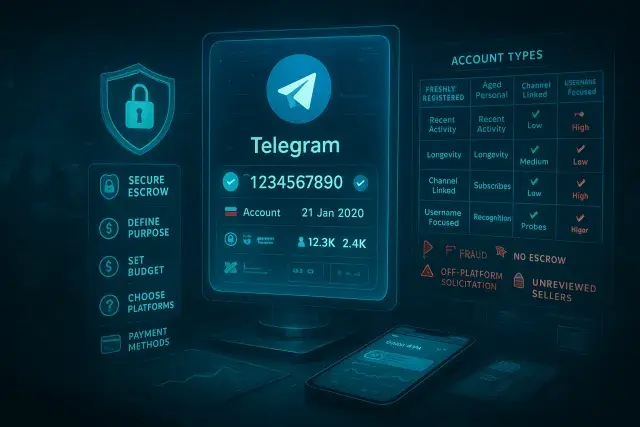
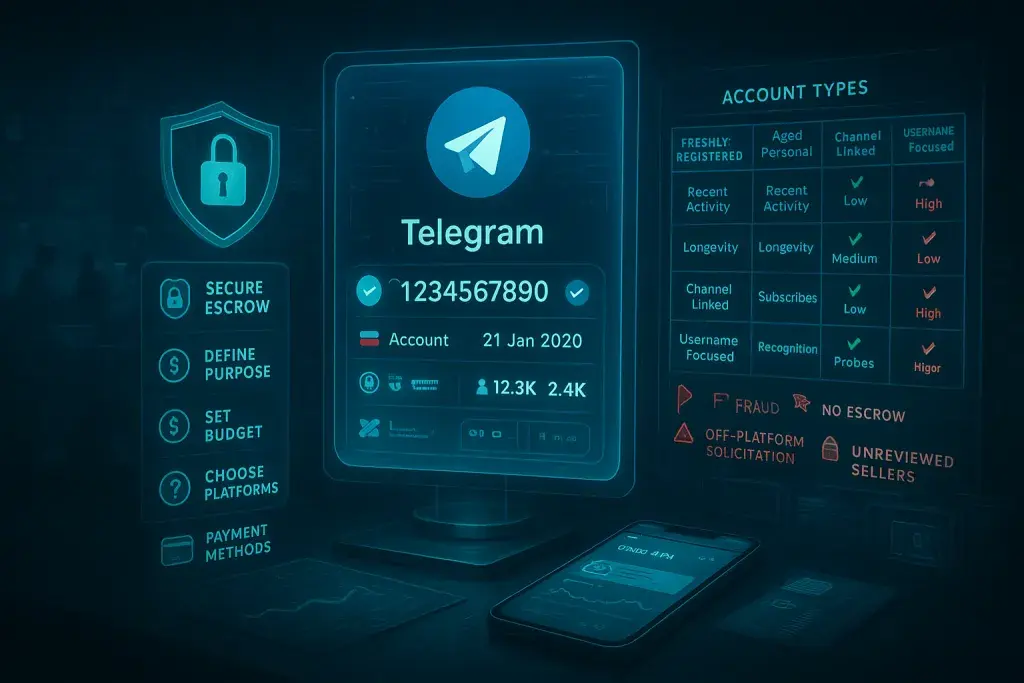
| Account Type | Typical Use Case | Value Drivers | Risk Level |
|---|---|---|---|
| Freshly registered | Automation, testing environments | Clean history, unlinked identity | Low to medium |
| Aged personal account | Business presence, trusted sender identity | Account age, activity history | Medium |
| Channel-linked account | Marketing, audience acquisition | Subscriber count, engagement history | Medium to high |
| Username-focused account | Brand identity, resale | Username desirability, brevity | Medium |
Understanding which account type fits your actual need prevents overpaying and reduces the chance of acquiring something that technically exists but cannot serve your purpose. A buyer who needs a trusted sender profile has different requirements than one who wants a channel with an existing audience - and conflating the two leads to poor purchasing decisions.
- Account age and creation date
- Phone number region and registration origin
- Username length, memorability, and availability
- Linked channels or groups and their subscriber counts
- Activity history and frequency of use
- Prior ban or restriction history
- Two-factor authentication status and recovery options
One important distinction: buying an account means acquiring full ownership and transfer of credentials, including the linked phone number or the ability to replace it. Renting access - where someone grants you login credentials without transferring ownership - leaves you with no real control and no recourse if access is revoked. Never confuse the two arrangements, and never pay ownership prices for access-only arrangements.
Navigating Telegram Account Marketplaces: Where Accounts Are Bought and Sold
Types of marketplaces and platforms
The Telegram account marketplace is not a single venue. Transactions happen across several distinct types of platforms, each with different levels of structure, protection, and risk. Knowing the difference is the first step toward choosing where to engage.
Dedicated account trading platforms are purpose-built for buying and selling social media and messaging accounts. They typically offer seller verification, standardized listing formats, and some form of buyer protection or dispute resolution. These platforms represent the most structured end of the spectrum and, for most buyers, the safest starting point.
General digital goods marketplaces host Telegram accounts alongside other digital assets. Protection varies widely depending on the platform's policies, and account listings may not be consistently verified or categorized.
Forum-based and community marketplaces - operating on dedicated trading forums or within Telegram groups themselves - function almost entirely on reputation. Buyers rely on seller feedback threads, vouches from other users, and manual verification. These venues can offer competitive pricing, but buyer protection is minimal and disputes are difficult to resolve.
Direct peer-to-peer sales, often initiated through social media or messaging channels, carry the highest risk. Without any intermediary, buyers have no recourse if the seller disappears after payment or delivers an account that has been previously flagged.
| Marketplace Type | Verification Level | Buyer Protection | Risk Level |
|---|---|---|---|
| Dedicated account platform | High | Escrow or dispute resolution | Low to medium |
| General digital goods marketplace | Medium | Platform-dependent | Medium |
| Forum or community trading | Low | Reputation-based only | Medium to high |
| Direct peer-to-peer | None | None | High |
When evaluating any platform for Telegram account trading, look for these trust signals before you engage with any listing:
- Escrow service that holds funds until the buyer confirms receipt and access
- Seller rating and review system with verified transaction history
- Clear dispute resolution process with a defined timeline
- Transparent listing standards that require specific account details
- Platform-level verification of seller identity or account authenticity
- Published refund or guarantee policy for failed transfers
Conversely, the following patterns are consistent warning signs that a platform or seller should not be trusted:
- No visible seller feedback or review history
- Listings that lack basic account details like creation date or phone number region
- Requests to move the transaction off-platform before payment
- Prices dramatically below market rate without explanation
- No identifiable dispute resolution channel
- Pressure to pay immediately without time to verify
Fraud in unregulated peer-to-peer markets follows predictable patterns: a seller delivers credentials that work briefly, then recovers the account using the original phone number. Without escrow and a proper transfer protocol, the buyer has no protection against this outcome.
How accounts are listed and priced
A legitimate Telegram account sale listing should contain enough information for a buyer to make an informed decision before initiating any contact. If a listing is vague, it is either poorly managed or deliberately obscuring information the seller doesn't want you to have before you're already committed.
Standard information a trustworthy listing should include:
- Account creation date or age in months and years
- Phone number registration country or region
- Username (if applicable) and its current availability
- Any linked channels or groups with current subscriber count
- Activity history summary (active, dormant, frequency of use)
- Confirmed absence of prior bans or restrictions
- Transfer method and what ownership change involves
Pricing in the Telegram account marketplace follows a few consistent patterns. Fixed-price listings are straightforward and common on structured platforms. Auction-style listings appear for high-demand usernames or accounts with large audiences, where competitive interest drives the price up. Negotiated sales are common in forum environments and for bulk purchases, where buyers acquiring multiple accounts at once may expect volume pricing.
As a general principle, pricing that seems dramatically favorable compared to similar listings on the same platform warrants extra scrutiny. Underpriced accounts may have undisclosed ban history, fabricated subscriber counts on linked channels, or simply fraudulent sellers testing for quick exits. A fair price for a well-documented account is a reasonable premium for transparency and lower risk.
Step-by-Step Guide to Purchasing a Telegram Account Safely
Preparing before you buy
The single most common reason account purchases go wrong is that buyers begin with a transaction in mind before they have clarity on what they actually need. Spending time on preparation before approaching any marketplace saves money, reduces risk, and results in an account that actually fits its intended purpose.
- Define your specific purpose. Are you acquiring an account for a personal project, business communications, marketing automation, or channel ownership? Each use case has different requirements for account age, linked assets, and phone number origin.
- Set a realistic budget. Research comparable listings before committing to a price range. Understanding market rates prevents both overpaying and being drawn toward suspiciously cheap options.
- Choose a platform type. Based on your risk tolerance and the value of the account you're targeting, decide whether a structured marketplace or a community forum is appropriate. Higher-value purchases warrant more structured platforms with better buyer protection.
- Prepare your verification questions. Before contacting any seller, have a list of account details you will require before proceeding. Sellers who cannot or will not provide this information are not worth pursuing.
- Confirm your payment method. Identify whether you will use an escrow service, a platform's built-in payment system, or another protected method. Have this arranged before you find a listing you want to act on.
Matching your use case to the right account type at this stage is the difference between an efficient purchase and a frustrating one. A buyer who needs a clean, unassociated account for automation does not need to pay a premium for a channel with 50,000 subscribers - and a buyer seeking audience reach should not be considering bare accounts without any following.
Evaluating a seller and verifying an account
Before any money changes hands, you should complete a structured verification process. This is not excessive caution - it is standard practice in any professional Telegram account trading context. The goal is to confirm that the account exists as described, has the history the seller claims, and can be legitimately transferred.
- Request the Telegram user ID. Ask the seller to provide the account's numerical user ID. This can be obtained by using any of the widely available Telegram bots that return a user's ID when a message is forwarded from their account. The user ID lets you cross-check account metadata independently.
- Verify account creation date. Some third-party services and bots can estimate approximate account age based on the user ID's numerical range, since IDs are assigned sequentially. Use this to cross-check the seller's claimed creation date.
- Request screenshot evidence. Ask for screenshots of the account settings showing the linked phone number's country code, account username, and any channel or group ownership. Screenshots can be fabricated, so treat them as one input among several rather than definitive proof.
- Check username history. If the account has a desirable username, verify through Telegram that the username is currently active and associated with the account you're evaluating.
- Ask about prior restrictions. Directly ask the seller whether the account has ever been restricted, banned temporarily, or flagged for spam. A seller who is honest about a minor past restriction is more trustworthy than one who claims a perfect history without evidence.
- Confirm the transfer method. Understand exactly how ownership will change hands. Will the phone number be transferred? Will a new SIM card be provided? Will access be given through a session transfer? Each method has different implications for long-term ownership security.
Sellers who resist reasonable verification requests are a clear signal to disengage. Legitimate sellers with genuine accounts have nothing to lose by providing basic documentation. Any hesitation about sharing the user ID, screenshots of ownership, or transfer method details should be treated as disqualifying.
Completing the transaction securely
Once you have verified the account to your satisfaction, the transaction itself requires as much care as the evaluation. A well-structured transfer protects both parties and ensures that ownership genuinely changes hands rather than being temporarily shared.
- Agree on all terms in writing. Before payment, confirm the transfer method, the timeline, what happens if the transfer fails, and who is responsible for what. On structured platforms, this may be handled by the platform's terms; in other environments, a written record in chat is your only documentation.
- Use escrow whenever available. Escrow holds your payment until you confirm that you have received working access to the account. This is the single most effective protection against the most common fraud pattern in account trading.
- Receive credentials and verify access immediately. As soon as you receive login information, verify that you can actually access the account before confirming the transaction to any escrow service.
- Change the linked phone number without delay. The original phone number is the master recovery credential for any Telegram account. Until you replace it with a number you control, the seller can recover the account at any time. This step is non-negotiable.
- Enable two-factor authentication. Add a strong password through Telegram's two-step verification feature immediately after gaining access.
- Review active sessions and linked apps. Check for any active sessions on other devices and terminate them. Review any bots or third-party apps connected to the account and remove those you did not authorize.
- Document the transfer. Save the conversation, the listing, any screenshots provided, and your own confirmation of access as a record. If issues arise later, this documentation is your evidence.
Sellers who push to receive payment before you have confirmed access, or who argue against the use of escrow, are telling you something important about what they expect the outcome of the transaction to be. The legitimate seller's interests are served by escrow too - it confirms payment - so resistance to it serves only one party's interests, and it is not yours.
Legal, Ethical, and Platform Compliance Considerations
Telegram's Terms of Service address account ownership primarily through the lens of responsibility rather than transferability. The platform does not offer an official account transfer mechanism, and its terms place ongoing responsibility for account activity on whoever controls the account at any given time. This means that if an account was used for prohibited activities before you purchased it, you may inherit the consequences of that history if Telegram acts on it after the transfer.
The legality of buying and selling Telegram accounts varies by jurisdiction. In many countries, there is no specific law addressing social media account trading directly, and transactions are governed by general contract law and consumer protection frameworks. In some jurisdictions, accounts with attached personal data - particularly channels that contain user message histories - may raise additional considerations under data protection regulations. If you are acquiring an account for commercial use at scale, consulting with a local legal professional before committing significant resources is a reasonable precaution.
| Compliance Area | What It Means in Practice | Risk if Ignored |
|---|---|---|
| Telegram Terms of Service | No official transfer mechanism; activity responsibility follows the account | Account suspension if prior violations surface |
| Local law | Account trading may intersect with contract law and data protection rules | Legal exposure in regulated industries or jurisdictions |
| Ethical use post-purchase | Using accounts for spam, manipulation, or fake engagement violates platform rules | Permanent ban and reputational damage |
| Data ownership | Channels with user data raise privacy questions if transferred without disclosure | Potential regulatory scrutiny in data-sensitive contexts |
There is a meaningful practical difference between purchasing an account for legitimate business use - maintaining a presence, managing communications, building a genuine audience - and purchasing one for activities that violate Telegram's rules, such as mass spam campaigns, fake follower inflation, or coordinated inauthentic behavior. The risks of the latter go beyond platform bans: they can include payment processor disputes, marketplace bans, and reputational damage that affects other projects.
Buying an account with a history of spam or platform violations is particularly problematic because Telegram's detection systems flag patterns over time. An account that appears clean at the moment of purchase may have accumulated behavioral signals that eventually trigger a restriction. This is why ban history verification, discussed in the previous section, is not optional - it is one of the most important pre-purchase checks available.
After acquiring any account, the safest path to compliance is straightforward: use it for genuine, transparent purposes; do not artificially inflate engagement metrics; and do not use it in ways that would violate the platform's terms regardless of whether you created the account yourself or purchased it. The acquisition method does not change what is permitted once you own the account.
Common Mistakes to Avoid When Buying or Trading Telegram Accounts
The patterns of failure in Telegram account purchasing are consistent enough that they can be anticipated and avoided. Most losses come not from sophisticated fraud but from buyers rushing past basic verification steps or prioritizing price over security.
- Skipping ban history verification. Purchasing an account without confirming it has no prior restrictions is the equivalent of buying a used vehicle without checking its service history. The account may work fine at first and fail weeks later when a delayed platform action catches up with its history.
- Paying outside of escrow. Direct bank transfers, cryptocurrency sent without escrow, or gift card payments to unverified sellers offer no recourse. Once the money is sent, it is gone. The marginal convenience of skipping escrow is not worth the total loss risk.
- Not changing the linked phone number immediately. This is the most exploitable oversight in account transfers. The original phone number remains a recovery path until it is replaced. Some sellers deliberately delay pointing this out, knowing the window for account recovery exists as long as the original number is still linked.
- Buying for the wrong use case. An account with a large subscriber channel costs significantly more than a clean bare account. Buyers who spend premium prices on attached assets they don't need are wasting money; buyers who acquire cheap accounts expecting functionality those accounts cannot provide will be disappointed.
- Trusting unreviewed sellers. Seller reviews on structured platforms exist for a reason. A seller with no history, or one whose reviews are suspiciously uniform and recent, should be treated with significant caution regardless of how attractive the listing appears.
- Failing to document the transfer process. Without records of the conversation, listing, and confirmation of access, disputes are nearly impossible to resolve in your favor. Documentation costs nothing and matters enormously when something goes wrong.
- Responding to off-platform solicitations. Sellers who contact you proactively and ask you to complete a transaction outside the marketplace you found them on are attempting to remove whatever buyer protection that marketplace provides. This pattern should end the conversation immediately.
The common thread in nearly all these mistakes is impatience. Account trading at a safe, professional level is not a fast process. Taking the time to verify, document, and use proper payment structures adds steps but removes the primary vectors through which buyers lose money or receive unusable accounts. Experienced traders treat this patience as standard operating procedure, not as an inconvenience.
Selling a Telegram Account: What You Need to Know
The seller's position in a Telegram account sale involves its own set of responsibilities and risks. Sellers who prepare properly, price honestly, and execute clean transfers build reputation in the marketplace; those who cut corners face disputes, chargebacks, and bans from the platforms where they operate.
What makes a Telegram account ready to sell
Before listing an account, sellers should complete a straightforward preparation process to maximize buyer confidence and minimize post-sale complications.
- Audit the account's history. Review any prior restrictions, bans, or unusual activity. Disclose these honestly in the listing - buyers who discover undisclosed issues after purchase will dispute the transaction and damage your seller reputation.
- Document account details thoroughly. Gather the creation date, phone number region, username status, linked channel information, and subscriber counts. Listings with complete, verifiable details convert better and attract more serious buyers.
- Choose a reputable marketplace. Selling on a structured platform with seller verification and escrow takes a percentage of the sale price but provides legitimacy, a ready pool of buyers, and protection against fraudulent chargeback attempts.
- Set a price based on comparable listings. Overpricing creates stale listings; underpricing signals poor quality. Research current market rates for accounts with similar age, username quality, and subscriber counts before setting your price.
- Prepare for the transfer process. Know in advance how you will transfer ownership - whether that involves providing a new SIM card, executing a session transfer, or another method - and be ready to execute it promptly after payment confirmation.
Sellers of channel-linked accounts should consider an additional complexity: channels with active subscriber bases may contain message histories, pinned content, or community context that buyers will want to evaluate. Be prepared to provide this information transparently. Channels where the audience was artificially inflated through paid fake followers are a liability, not an asset - buyers increasingly perform basic audience quality checks, and a fraudulent subscriber count will end in a dispute.
| Account Condition | Expected Buyer Interest | Key Selling Points |
|---|---|---|
| Clean aged account, no channel | Moderate - automation, business use buyers | Account age, clean history, phone number origin |
| Desirable short username | High among brand-focused buyers | Username length, memorability, availability |
| Channel with genuine audience | High - marketing and content buyers | Subscriber count, engagement rate, niche relevance |
| Previously restricted account | Low - limited use cases, price-sensitive buyers | Must disclose; price accordingly |
Writing a compelling listing means providing accurate, specific information rather than promotional language. Buyers looking to purchase Telegram profiles are experienced enough to recognize inflated descriptions, and they trust specifics far more than adjectives. State the account's creation period, its activity history honestly, what the transfer involves, and what the buyer can expect to control after the transaction is complete. Clear, factual listings close faster and generate fewer post-sale disputes than vague ones that leave buyers with unanswered questions.
One note for sellers of accounts with attached channels: if the channel contains user-generated content or retains data from previous subscriber interactions, you have an ethical obligation to be transparent about this with the buyer. In some contexts, particularly where subscriber data is subject to privacy protections, this may also be a legal consideration. When in doubt, list the content as part of the asset description and let buyers make informed decisions.
Questions and Answers
Can Telegram detect and ban an account after it has been transferred to a new owner?
Yes. Telegram's moderation systems act on account-level behavioral history, not on who currently controls the account. If an account was used for spam or prohibited activities before the sale, platform action can occur after the transfer. This is why checking ban and restriction history before purchasing is essential - you inherit the account's record along with its credentials.
What is the safest way to acquire Telegram user ID details before committing to a purchase?
Ask the seller to forward a message from the account to a Telegram bot that returns user ID information, or have them send you a message from the account directly so you can check the ID through a third-party tool. The user ID is permanent and can be used to cross-check account age estimates, since IDs are assigned sequentially at registration. A seller who refuses to provide verifiable user ID data has no legitimate reason for that refusal.
How do escrow services work in the context of Telegram account trading, and are they always available?
Escrow holds the buyer's payment until the buyer confirms that the transfer has been completed successfully and that access to the account works as described. On dedicated account trading platforms, escrow is typically built into the checkout process. In forum or P2P environments, escrow may be offered by trusted third parties within those communities, though the reliability of such services varies. If no credible escrow option is available for a high-value purchase, that is a strong reason to use a structured marketplace instead.
What should I do if an account I purchased stops working or is recovered by the seller shortly after the transaction?
If you used escrow and have not yet released funds, contact the platform's dispute resolution team immediately with your documentation. If funds were already released, file a dispute with the marketplace if one is available. Preserve all communication records, the original listing, and screenshots showing you had access before losing it. In P2P transactions with no escrow and no platform intermediary, recovery options are severely limited, which is the central argument for using structured platforms in the first place.
Does the phone number region of a Telegram account affect how it performs after purchase?
It can, depending on your intended use. Accounts registered with numbers from certain countries are subject to different rate limits, verification requirements, and spam detection sensitivity. For use cases involving high message volume or large group management, the registration region can affect day-to-day functionality. Buyers with specific operational requirements should clarify the phone number's origin country before purchasing and, where necessary, plan to replace the linked number with one from a preferred region after the transfer.
Is it possible to verify a Telegram channel's subscriber quality before purchasing an account that owns it?
A basic evaluation is possible. Review the channel's engagement rate - the ratio of views and reactions to subscriber count. Channels with large subscriber numbers but very low engagement per post are common indicators of inflated or inactive follower bases. You can also observe the posting history for consistency and authenticity. No tool provides perfect audience verification, but significant discrepancies between subscriber count and actual engagement are a reliable warning sign that the audience is not as valuable as the headline number suggests.